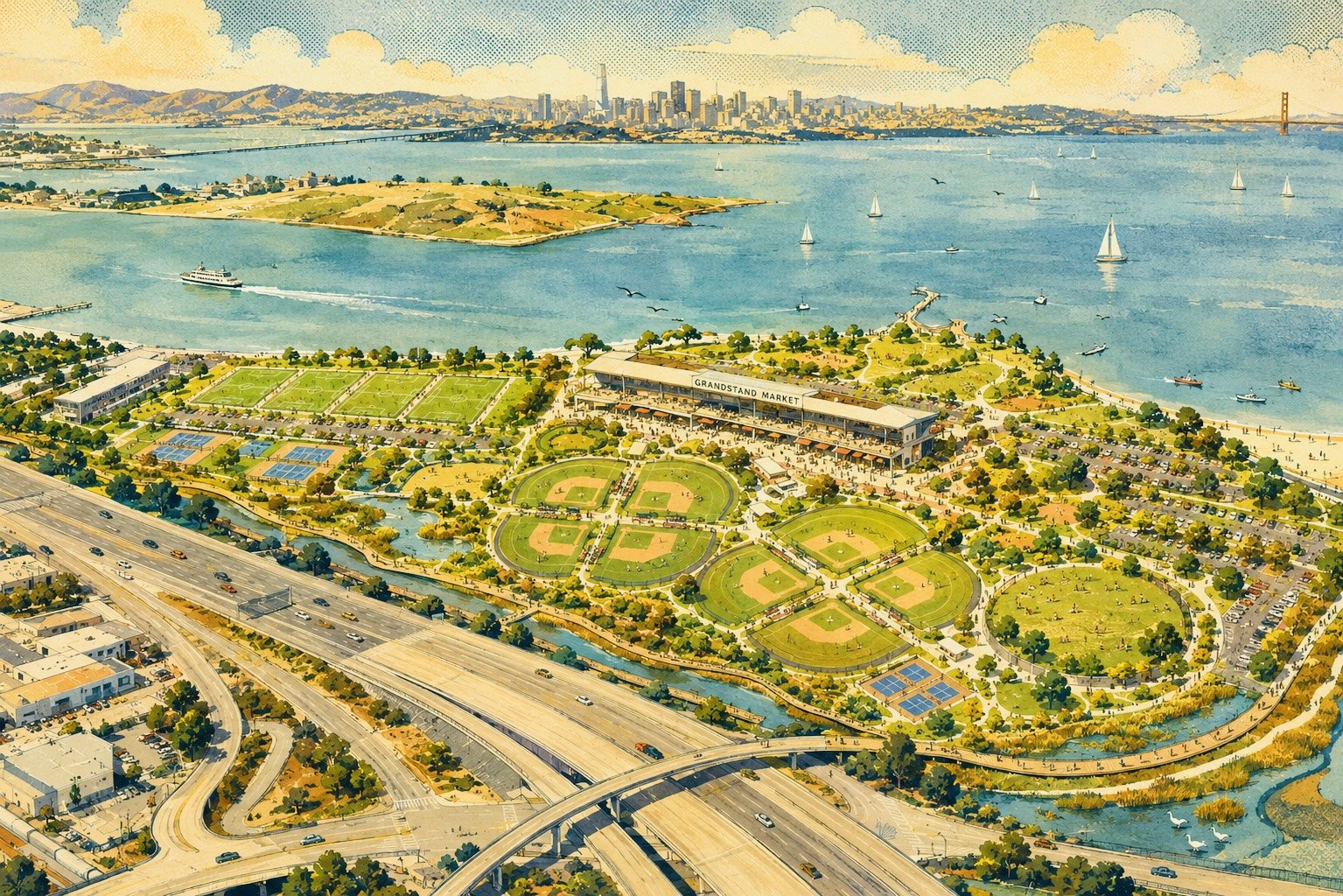
Golden Gate Fields: Preserve the Possibilities
Before we erase what’s there, let’s ask what this place could become.
Golden Gate Fields is moving closer to public ownership.
The State of California has committed $125 million toward the acquisition, East Bay Regional Park District has committed $20 million, and Trust for Public Land is working to raise the remaining $30 million needed for the $175 million purchase. EBRPD's board is expected to vote on the proposed purchase on October 6.
We strongly support bringing Golden Gate Fields into public ownership.
But acquisition is only the beginning.
Some consequential decisions about what happens next are already being made before the larger community process has really begun. Are we narrowing the range of possibilities before we've given ourselves permission to think creatively, take risks, and ask what this place could become?
For me, there are two questions that are absolutely critical:
How much of what already exists can we creatively reuse and re-envision?
And:
What is the economic engine that can help build and sustain this park for generations?
$175 Million. What Are We Getting?
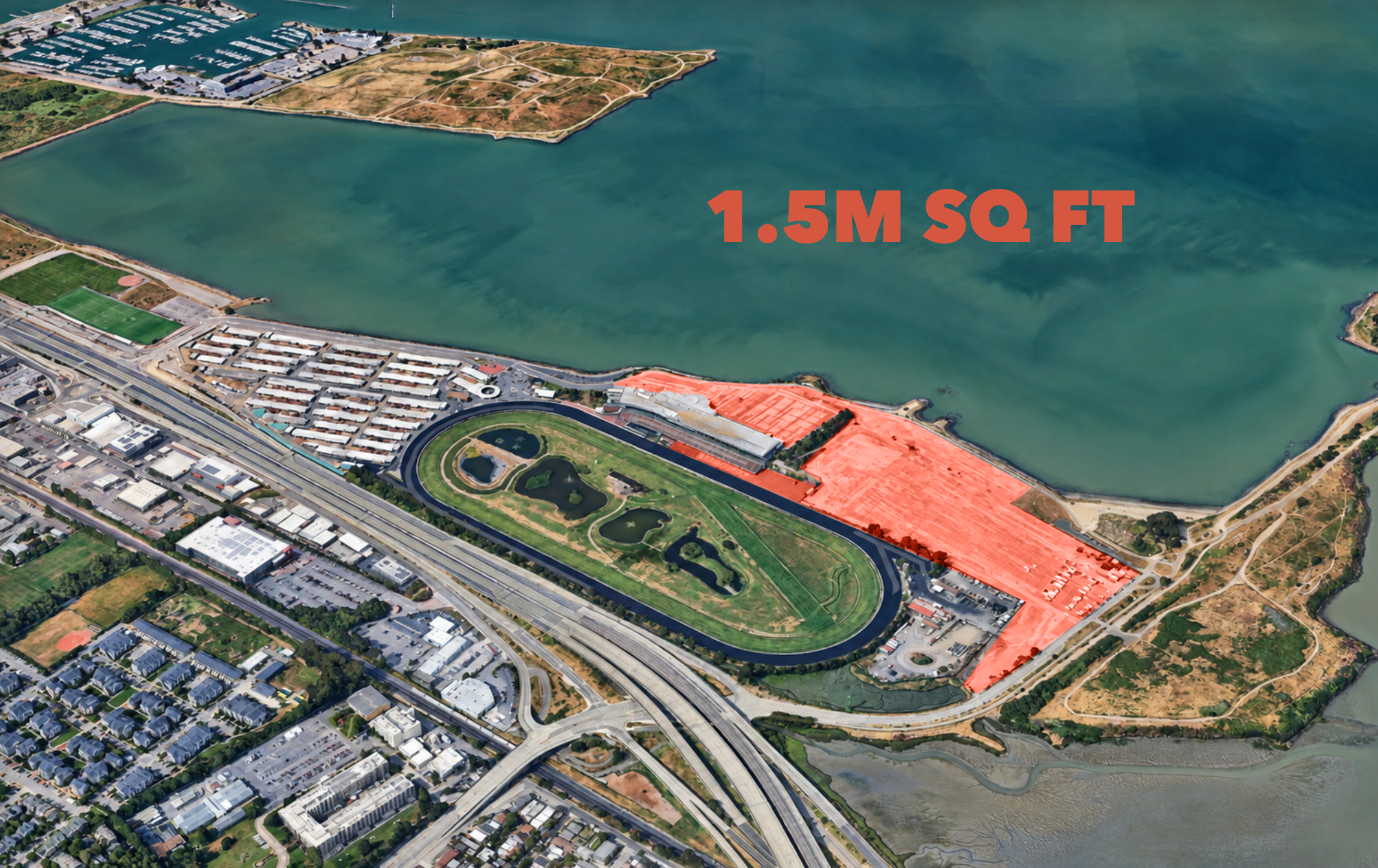
What happens with 1.5 Million Square Feet of Asphalt Paving?
Golden Gate Fields encompasses roughly 160 acres, including approximately 30 acres underwater.
The terms of the acquisition call for the existing structures to be demolished and the site cleared as part of the sale.
That is not an insignificant detail.
After spending $175 million to acquire the property—and millions more being spent by the existing owner on demolition—what exactly will the public inherit?
Roughly 1.5 million square feet of asphalt and a hillside full of concrete foundations, footings and rebar.
That isn't a park.
And it isn't a blank slate.
In many ways, demolition creates an entirely new—and potentially more difficult—starting point.
Before we erase what is there, we should understand what we have.
We have submitted a formal letter to the City of Albany regarding the demolition permit for Golden Gate Fields, asking the City to ensure that the proposed demolition receives appropriate environmental review before work proceeds.
The demolition of a site of this scale raises significant questions about dust and air quality, hazardous materials, truck traffic, noise and vibration, wildlife and habitat, shoreline and water quality impacts, as well as the cumulative effects of removing the entire complex.
The letter also asks an important larger question: should we authorize irreversible demolition before we have adequately studied what is there and whether portions of the existing structures could be reused?
This is not an argument to preserve everything—it is a request for due diligence, transparency, and environmental review before we permanently eliminate options for the site's future.
Reuse Is Not the Same as Preservation
This distinction is important.
We are not advocating for preservation of the Golden Gate Fields grandstand.
This distinction is important.
We are not advocating for preservation of the Golden Gate Fields grandstand.
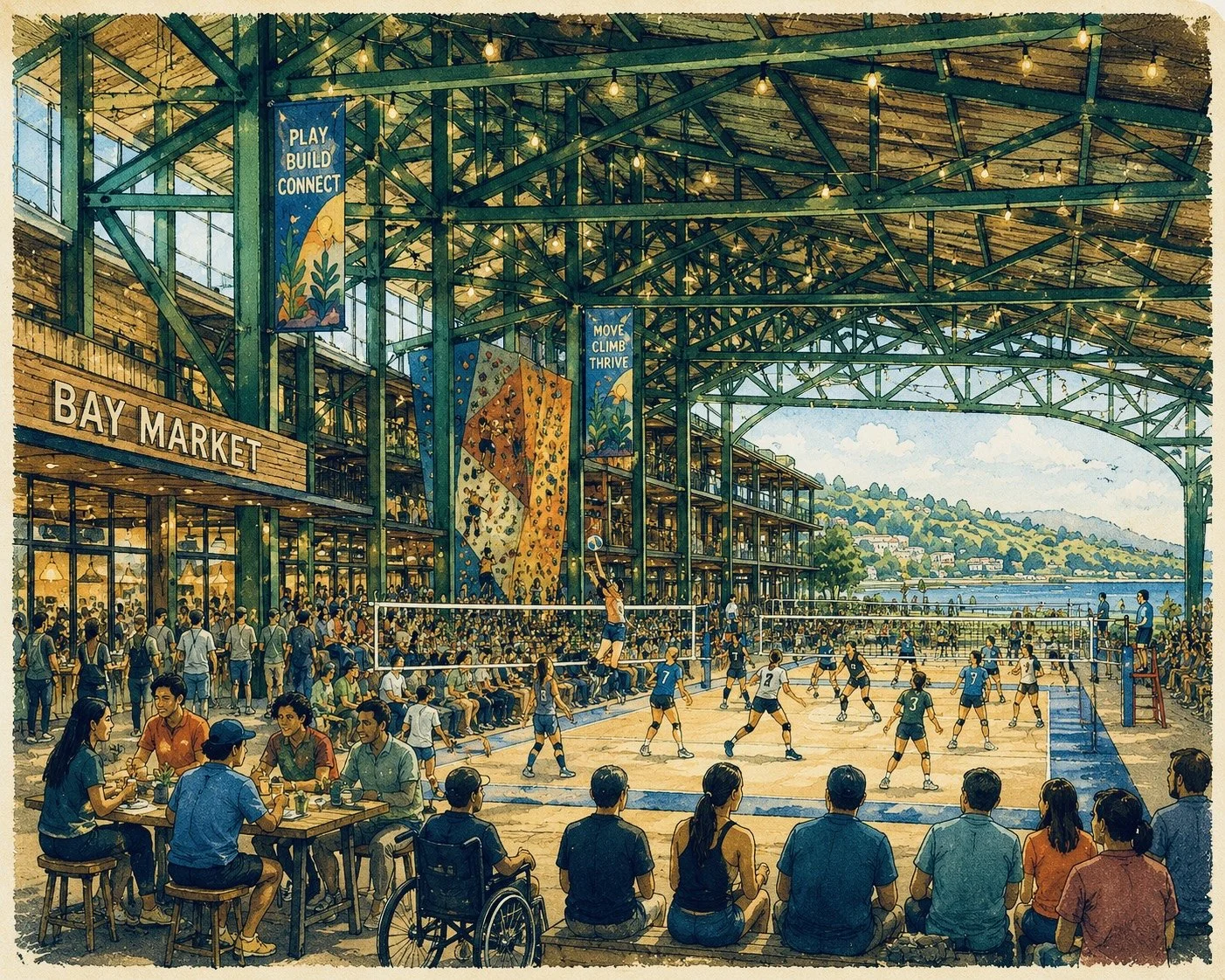
We are advocating for creative reuse and re-envisioning of an immense concrete-and-steel structure before 100 percent of it is demolished.
This is a structure of a scale we will realistically never build on the East Bay waterfront again.
Could we reuse half of it?
A quarter?
Could part become a major indoor recreation facility? A botanical conservatory? A marketplace? A tournament pickleball facility?
Could several of these things happen at once?
We don’t know. And that’s precisely the point.
These aren’t proposals. They’re questions.
Before an irreversible decision is carried out, architects, engineers, park designers, environmental professionals, operators, economists—and the public—should have an opportunity to investigate them.
Once the structure is gone, that opportunity is gone with it.
An Environmental Question
There is also an uncomfortable environmental contradiction worth discussing.
A substantial portion of the public money being used to acquire Golden Gate Fields comes from state environmental and climate funding.
At the same time, the acquisition terms contemplate demolishing the site’s massive concrete-and-steel structures.
Demolition may ultimately prove to be the right answer for some—or even much—of what exists.
But shouldn’t adaptive reuse be one of the first environmental questions we investigate, rather than one of the last?
Before we throw away an enormous existing investment of concrete, steel and embodied carbon, we should understand whether some portion of it can have another life.
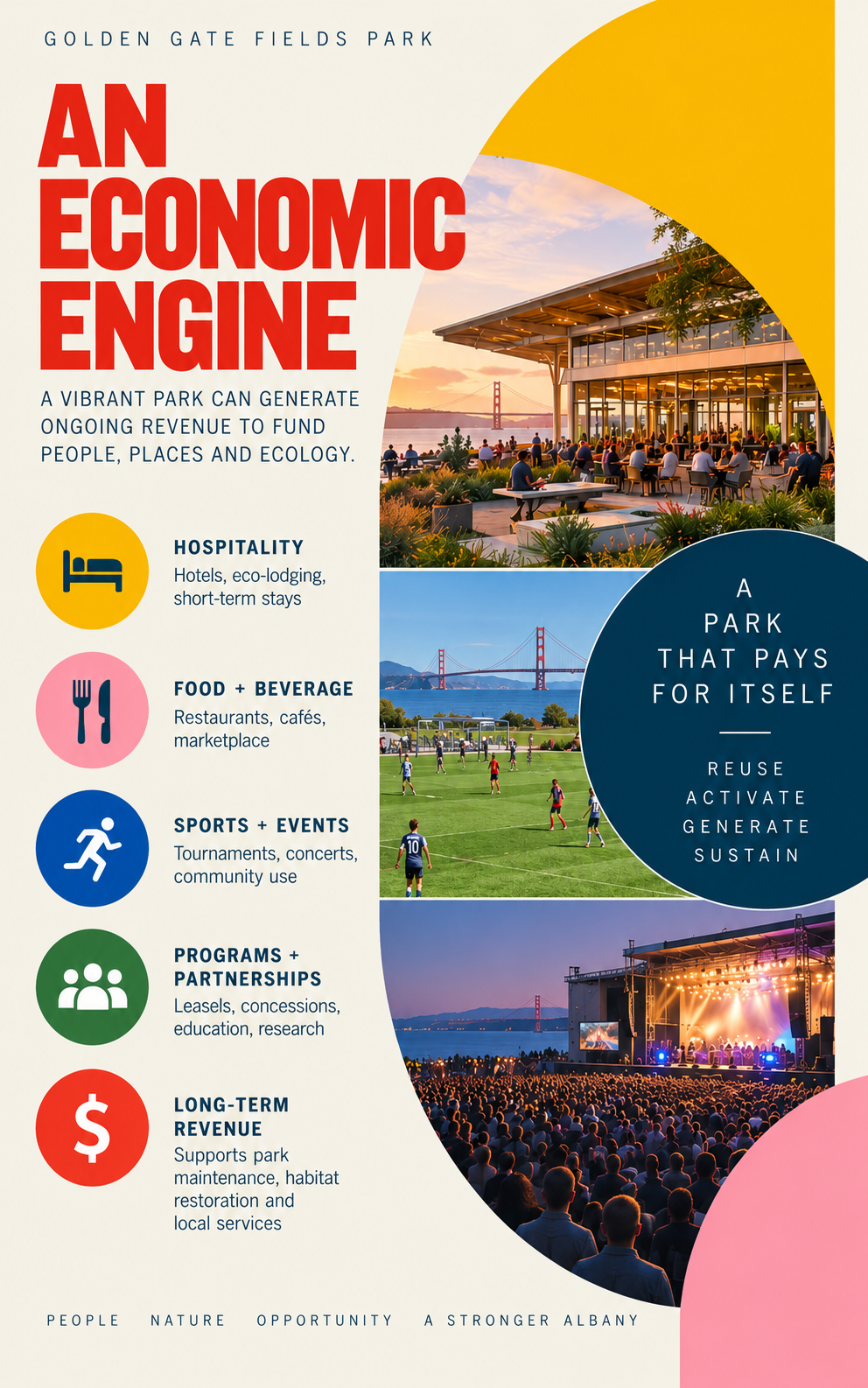
What Is the Economic Engine?
This may ultimately be an even bigger question.
We have secured significant funding to acquire Golden Gate Fields. We do not yet have the money to build—or really sustain—the kind of world-class park this site could become.
Acquisition is only the first investment.
What pays to restore habitat?
What pays to adapt the shoreline to sea-level rise?
What pays for recreation facilities, infrastructure and public spaces?
And what pays to operate, maintain and continually improve this landscape for the next 50 or 100 years?
Could active recreation help generate revenue? Restaurants? Events? Hospitality? Ground leases? Could a small portion of the property accommodate another compatible use that generates substantial resources for the rest of the park?
We don’t know.
And these are exactly the kinds of questions the community process should explore.
Getting Out of the Unfortunate Middle
A waterfront that is as culturally important to our communities as it is ecologically important to the region.
A place that restores habitat while inviting people into the landscape.
A place that accommodates serious recreation while creating new ways to experience the Bay.
And a place with the financial resilience to continually improve rather than simply struggle to maintain what was built.
Golden Gate Fields may be our one chance to get out of the unfortunate middle.
For too long, the East Bay waterfront has occupied an unfortunate middle.
We don’t have a truly great ecological waterfront, nor have we created a great civic waterfront.
Golden Gate Fields gives us a rare opportunity to challenge that.
We can imagine a waterfront we’re proud to bring our families and visitors to—a place where we play, eat, gather, explore and experience the Bay.