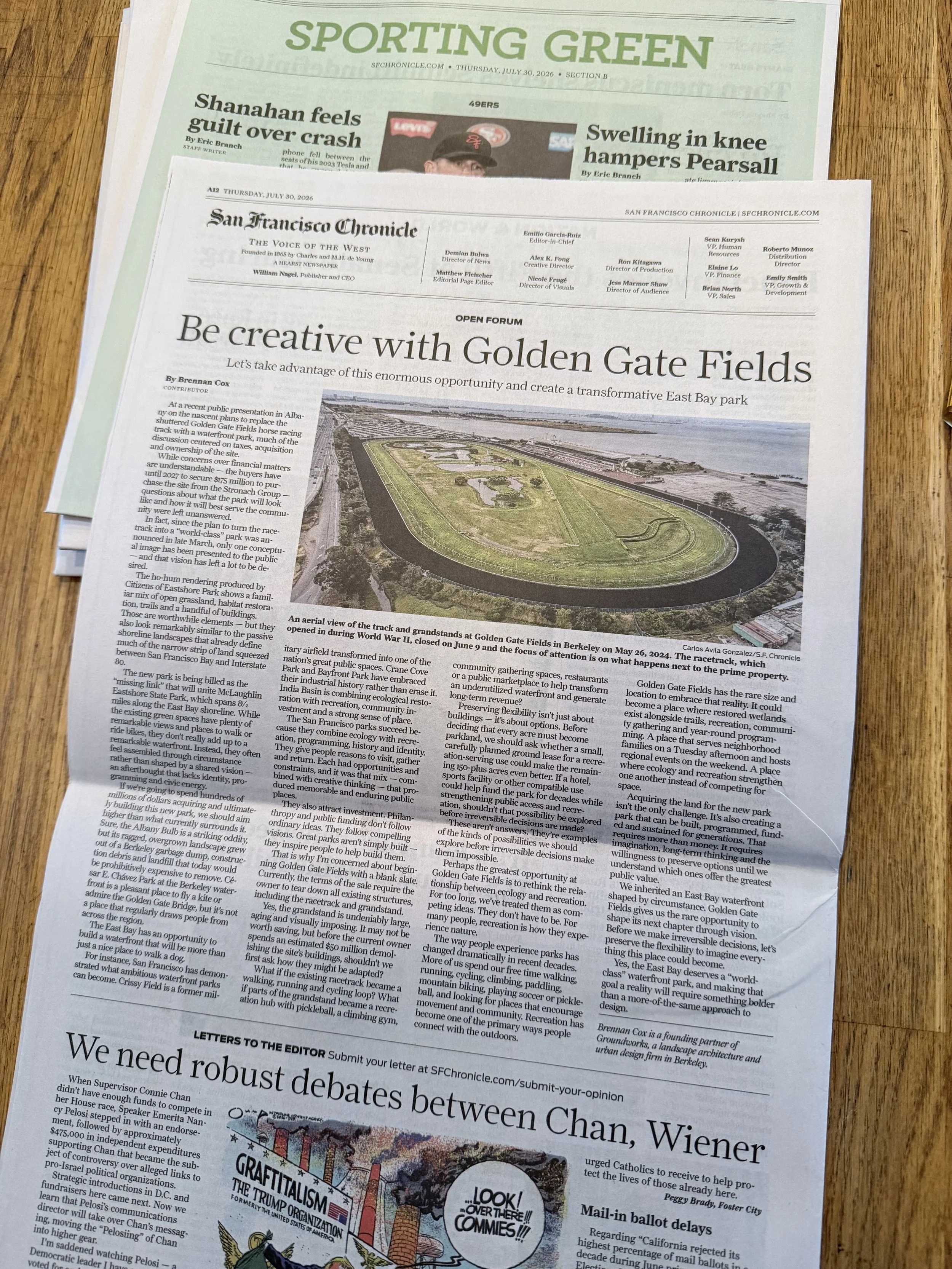
The park at Golden Gate Fields could be the next Crissy Field — if we dare to dream
At a recent public presentation in Albany on the nascent plans to replace the shuttered Golden Gate Fields horse racing track with a waterfront park, much of the discussion centered on taxes, acquisition and ownership of the site.
While concerns over financial matters are understandable — the buyers have until 2027 to secure $175 million to purchase the site from the Stronach Group — questions about what the park will look like and how it will best serve the community were left unanswered.
In fact, since the plan to turn the racetrack into a “world-class” park was announced in late March, only one conceptual image has been presented to the public — and that vision has left a lot to be desired.
The ho-hum rendering produced by Citizens of Eastshore Park shows a familiar mix of open grassland, habitat restoration, trails and a handful of buildings. Those are worthwhile elements — but they also look remarkably similar to the passive shoreline landscapes that already define much of the narrow strip of land squeezed between San Francisco Bay and Interstate 80.
The new park is being billed as the “missing link” that will unite McLaughlin Eastshore State Park, which spans 8½ miles along the East Bay shoreline. While the existing green spaces have plenty of remarkable views and places to walk or ride bikes, they don’t really add up to a remarkable waterfront. Instead, they often feel assembled through circumstance rather than shaped by a shared vision — an afterthought that lacks identity, programming and civic energy.
If we’re going to spend hundreds of millions of dollars acquiring and ultimately building this new park, we should aim higher than what currently surrounds it. Sure, the Albany Bulb is a striking oddity, but its ragged, overgrown landscape grew out of a Berkeley garbage dump, construction debris and landfill that today would be prohibitively expensive to remove. César E. Chávez Park at the Berkeley waterfront is a pleasant place to fly a kite or admire the Golden Gate Bridge, but it’s not a place that regularly draws people from across the region.
The East Bay has an opportunity to build a waterfront that will be more than just a nice place to walk a dog.
For instance, San Francisco has demonstrated what ambitious waterfront parks can become. Crissy Field is a former military airfield transformed into one of the nation’s great public spaces. Crane Cove Park and Bayfront Park have embraced their industrial history rather than erase it. India Basin is combining ecological restoration with recreation, community investment and a strong sense of place.
The San Francisco parks succeed because they combine ecology with recreation, programming, history and identity. They give people reasons to visit, gather and return. Each had opportunities and constraints, and it was that mix — combined with creative thinking — that produced memorable and enduring public places.
They also attract investment. Philanthropy and public funding don’t follow ordinary ideas. They follow compelling visions. Great parks aren’t simply built — they inspire people to help build them.
That is why I’m concerned about beginning Golden Gate Fields with a blank slate. Currently, the terms of the sale require the owner to tear down all existing structures, including the racetrack and grandstand.
Yes, the grandstand is undeniably large, aging and visually imposing. It may not be worth saving, but before the current owner spends an estimated $50 million demolishing the site’s buildings, shouldn’t we first ask how they might be adapted?
What if the existing racetrack became a walking, running and cycling loop? What if parts of the grandstand became a recreation hub with pickleball, a climbing gym, community gathering spaces, restaurants or a public marketplace to help transform an underutilized waterfront and generate long-term revenue?
Preserving flexibility isn’t just about buildings — it’s about options. Before deciding that every acre must become parkland, we should ask whether a small, carefully planned ground lease for a recreation-serving use could make the remaining 150-plus acres even better. If a hotel, sports facility or other compatible use could help fund the park for decades while strengthening public access and recreation, shouldn’t that possibility be explored before irreversible decisions are made?
These aren’t answers. They’re examples of the kinds of possibilities we should explore before irreversible decisions make them impossible.
Perhaps the greatest opportunity at Golden Gate Fields is to rethink the relationship between ecology and recreation. For too long, we’ve treated them as competing ideas. They don’t have to be. For many people, recreation is how they experience nature.
The way people experience parks has changed dramatically in recent decades. More of us spend our free time walking, running, cycling, climbing, paddling, mountain biking, playing soccer or pickleball, and looking for places that encourage movement and community. Recreation has become one of the primary ways people connect with the outdoors.
Golden Gate Fields has the rare size and location to embrace that reality. It could become a place where restored wetlands exist alongside trails, recreation, community gathering and year-round programming. A place that serves neighborhood families on a Tuesday afternoon and hosts regional events on the weekend. A place where ecology and recreation strengthen one another instead of competing for space.
Acquiring the land for the new park isn’t the only challenge. It’s also creating a park that can be built, programmed, funded and sustained for generations. That requires more than money. It requires imagination, long-term thinking and the willingness to preserve options until we understand which ones offer the greatest public value.
We inherited an East Bay waterfront shaped by circumstance. Golden Gate Fields gives us the rare opportunity to shape its next chapter through vision. Before we make irreversible decisions, let’s preserve the flexibility to imagine everything this place could become.
Yes, the East Bay deserves a “world-class” waterfront park, and making that goal a reality will require something bolder than a more-of-the-same approach to design.